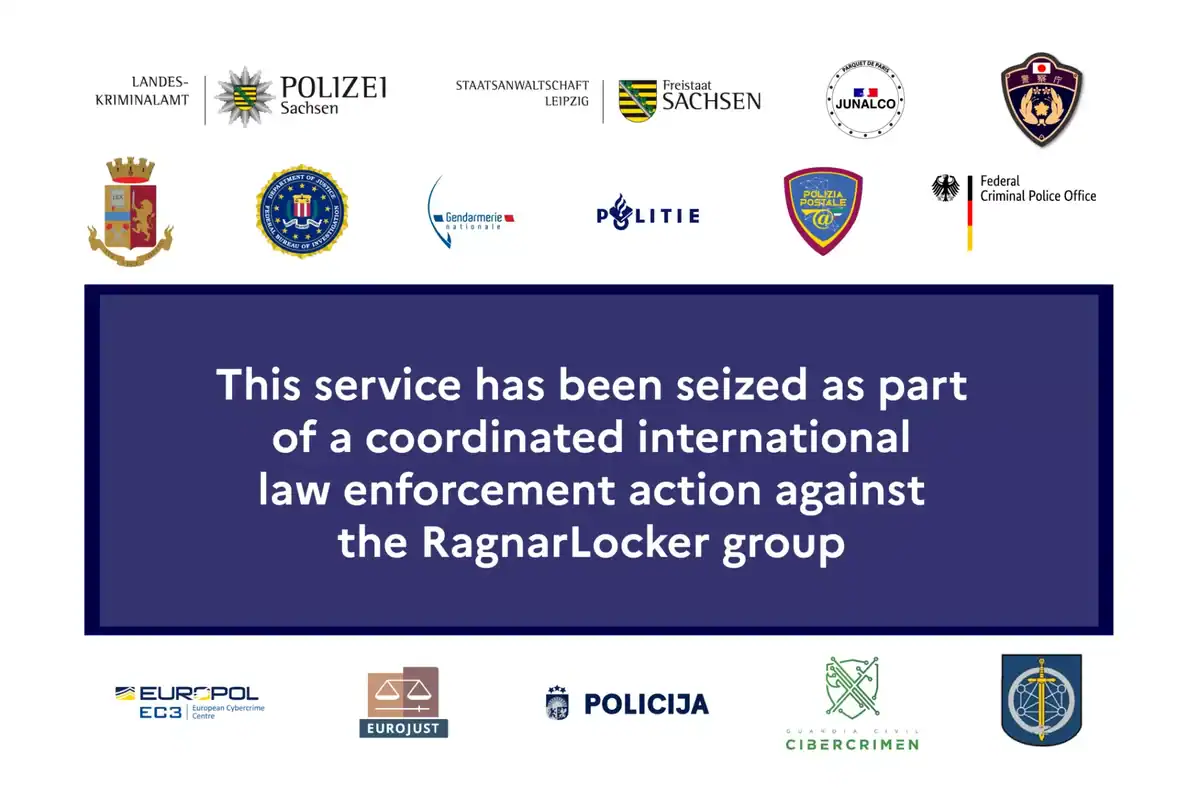
A major cybercriminal organization responsible for devastating attacks on critical infrastructure worldwide has been dismantled following a coordinated international operation spanning eleven countries.
Law enforcement agencies led by Europol and Eurojust successfully disrupted the Ragnar Locker ransomware group during operations conducted between October 16-20, marking a significant victory in the ongoing battle against cybercrime. The operation resulted in multiple arrests and the seizure of key infrastructure used by the criminal network.
The breakthrough came with the arrest of the group's primary target in Paris, France on October 16, identified as a suspected developer for the Ragnar operation. Following his apprehension, authorities conducted a search of his residence in the Czech Republic. The investigation quickly expanded, with five additional suspects interrogated in Spain and Latvia over the following days.


"We recognize the threat posed by ransomware operations, and our collaboration with international partners has made it clear that we will not tolerate these attacks," stated Europol's representative.
"We recognize the threat posed by ransomware operations, and our collaboration with international partners has made it clear that we will not tolerate these attacks,"
The operation extended beyond arrests, with authorities successfully dismantling critical components of the ransomware infrastructure. Teams in the Netherlands, Germany, and Sweden seized servers and equipment used by the criminal network, while Swedish authorities shut down the group's data leak site operating on the Tor network.

This week's coordinated strikes represent the culmination of a complex, multi-year investigation initiated by the French National Gendarmerie in October 2021. The investigation brought together law enforcement agencies from France, Germany, Italy, Japan, the Netherlands, Spain, Sweden, Ukraine, and the United States in an unprecedented display of international cooperation.
"Effective international collaboration is essential in combating cyber threats that know no borders," emphasized a spokesperson from Eurojust.
"Effective international collaboration is essential in combating cyber threats that know no borders,"


Ragnar Locker first appeared on the cybercrime landscape in December 2019, quickly establishing itself as one of the most dangerous ransomware operations targeting critical infrastructure globally. The group gained notoriety for high-profile attacks on major organizations, including the Portuguese national airline and a hospital in Israel, demonstrating their willingness to target essential services regardless of potential humanitarian consequences.
The ransomware specifically targeted devices running Microsoft Windows, often exploiting vulnerabilities in open services like Remote Desktop Protocol to gain unauthorized access to victim networks. Once inside, the attackers would deploy their malicious software to encrypt critical data and systems.
What made Ragnar Locker particularly dangerous was their adoption of "double extortion" tactics. Rather than simply encrypting victims' data and demanding payment for decryption tools, the group would also steal sensitive information and threaten to release it publicly if ransom demands weren't met. This approach significantly increased pressure on victims and raised the stakes of each attack.
"double extortion"
"The level of threat posed by Ragnar Locker was classified as high due to its attacks on vital infrastructures," noted a cybersecurity analyst involved in the investigation.
"The level of threat posed by Ragnar Locker was classified as high due to its attacks on vital infrastructures,"
The criminal organization demonstrated particular audacity in their approach to victims, explicitly warning against cooperation with law enforcement. On their Darknet leak site, the group declared: "Everything the FBI and ransomware negotiators do complicates things; we will publish your data if you call for help."
However, unbeknownst to the criminals, law enforcement was already closing in. The initial breakthrough came in October 2021 when investigators from the French Gendarmerie and U.S. FBI, supported by specialists from Europol and INTERPOL, conducted operations in Ukraine that led to the arrests of two key Ragnar Locker operatives.
The European Cybercrime Centre of Europol played a pivotal role throughout the investigation, coordinating efforts between participating countries and developing a comprehensive strategy to dismantle the network. The complexity of the operation required extensive preparation, with cybercrime experts organizing 15 coordination meetings and dedicating two intensive weeks to operational planning.
"Our cybercrime experts organized 15 coordination meetings and two weeks of intense preparation for these operations, providing analytical, malware-related, forensic, and crypto-based support," explained a representative from Europol.
"Our cybercrime experts organized 15 coordination meetings and two weeks of intense preparation for these operations, providing analytical, malware-related, forensic, and crypto-based support,"
To ensure seamless coordination during the critical operational phase, Europol established a virtual command post that allowed real-time communication and coordination between all participating authorities across multiple time zones and jurisdictions.
Eurojust's contribution proved equally vital, facilitating judicial cooperation since the case's formal initiation in May 2021 at the request of French authorities. The organization coordinated five separate meetings to ensure legal frameworks aligned across participating countries, enabling the complex international operation to proceed smoothly.
Looking Ahead
The successful dismantling of Ragnar Locker represents more than just the elimination of a single criminal network. It demonstrates the growing effectiveness of international cooperation in combating cybercrime and sends a clear message to other ransomware operators that geographic boundaries provide no sanctuary from justice. As cyber threats continue to evolve and cross borders with impunity, operations like this establish crucial precedents for future collaborative enforcement efforts.