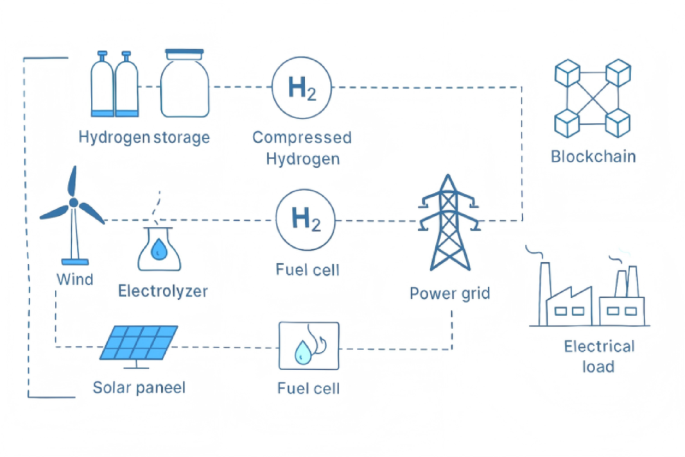
The ongoing digital transformation in energy systems, particularly those integrating hybrid hydrogen technologies, presents significant cybersecurity challenges. Traditional cyberattack models often fall short of addressing these emerging vulnerabilities effectively, leading to the need for innovative solutions. A team of researchers has developed a novel cyberattack framework that promises to shift the landscape of cybersecurity in energy systems.
"The increasing integration of digital technologies in hybrid hydrogen-power networks has introduced new cybersecurity vulnerabilities that existing static or single-phase cyberattack models fail to adequately exploit or defend against," said Mohannad Alhazmi, one of the study's co-authors. This new framework is known as the Cyberattack Design Based on CNN-DQN-Blockchain Technology for Targeted Adaptive Strategy (CDB-TAS).
"The increasing integration of digital technologies in hybrid hydrogen-power networks has introduced new cybersecurity vulnerabilities that existing static or single-phase cyberattack models fail to adequately exploit or defend against,"


Qualifying
CDB-TAS is not just another model; it represents a comprehensive approach to cyberattacks that encompasses three critical phases, each designed to enhance its effectiveness. The first phase, the Preliminary Reconnaissance Phase, utilizes a Convolutional Neural Network (CNN) to detect the most vulnerable components of the grid in real-time. "During this phase, our model identifies the most vulnerable buses via real-time anomaly detection," explained Alexis Pengfei Zhao, a key contributor to the research.
"During this phase, our model identifies the most vulnerable buses via real-time anomaly detection,"

Qualifying
Qualifying


Qualifying
Once vulnerabilities are identified, the model advances to the Escalation Phase, where a Double Deep Q-Network (Double DQN) refines the attack strategy based on real-time grid responses and demand profiles. "This phase is crucial for adapting the attack depending on how the grid reacts," stated Xi Cheng, another researcher involved in the study. This adaptability is vital as it allows the attack to evolve alongside the grid, enhancing its chances of success.
"This phase is crucial for adapting the attack depending on how the grid reacts,"
The final stage, the Sustained Attack Phase, aims to maintain prolonged disruptions while continuously adapting to minimize detection risks. As Cheng noted, "This phase maintains high-intensity disruptions while minimizing detection through continuous feedback adaptation."
Interestingly, the study also introduces an attacker-side obfuscation mechanism using private blockchain technology. This aspect of CDB-TAS does not focus on defense; instead, it serves to conceal attack metadata and facilitate decentralized coordination among malicious nodes. "Using blockchain technology as a layer of obfuscation for the attacker’s operations presents an innovative twist in how we think about cyber threats," said Chenlu Yang, who also contributed to the research.
"Using blockchain technology as a layer of obfuscation for the attacker’s operations presents an innovative twist in how we think about cyber threats,"
By the Numbers
Simulations conducted using a synthetic 2000-bus hybrid hydrogen-power system, modeled on the Electric Reliability Council of Texas (ERCOT), yield alarming results. The simulations reveal that the CDB-TAS framework can produce voltage drops of up to 15% at critical buses while disrupting over 600 MW of load across 50 substations. "We achieved 23.4% higher disruption efficiency with lower anomaly detection rates compared to baseline attacks," noted Alhazmi. This statistic highlights the potential severity and effectiveness of multidimensional cyber threats.
The introduction of this framework signals a crucial step forward in understanding how adaptive cyberattacks could affect the evolving energy landscape. By integrating convolutional neural networks, reinforcement learning, and blockchain technology, the CDB-TAS model offers profound insights into the cybersecurity challenges faced by multi-energy systems today.
As energy networks continue to evolve, this research underlines the importance of developing proactive and adaptable cybersecurity strategies. It provides a framework that not only highlights vulnerabilities but also encourages the creation of new defenses against increasingly sophisticated cyber threats.
Looking Ahead
Researchers emphasize the need for further exploration of this integrated framework, indicating potential implications for the future of cybersecurity in multi-energy systems. With the complexities of energy infrastructure continuing to deepen, the ability to adapt to new threats will be paramount in ensuring the resilience of these critical services.